
How inbound marketing actually drives growth
Most teams are active.
But growth still feels inconsistent. That’s because activity is not the same thing as structure. Inbound marketing drives growth when your visibility, messaging, content, and conversion paths are intentionally designed to work together. Without that structure, growth stagnates instead of compounding.

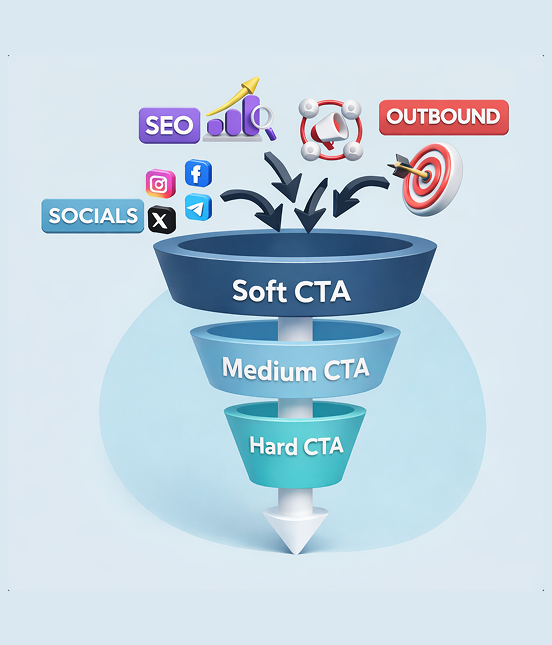
What an inbound marketing system really is
An Inbound Marketing System (IMS) is the coordination layer behind your growth efforts.
It ensures that:
When those pieces are aligned, growth becomes more consistent. When they’re not, even good marketing underperforms.
What an inbound marketing system looks like in practice
A functional IMS has four coordinated layers.
This is how people enter your ecosystem. It may include:
Inbound does not replace outbound or paid channels. It supports them. When someone clicks your ad or reads your cold email, they rarely convert immediately. They research. They compare. They evaluate. Inbound is the system that supports that evaluation.
Once someone lands on your site, there should be no ambiguity.
They should understand:
This is not about clever copy. It’s about structural messaging alignment across your homepage, service pages, and content. If clarity is weak, traffic leaks immediately.
In high-trust industries — like DeFi, infrastructure, technical services, and complex B2B — people do not convert instantly.
They evaluate. Trust infrastructure includes:
Without trust, growth depends heavily on persuasion. With trust, conversations begin warmer and closer to decision.
This is where many teams fall short.
Inbound is not just about having CTAs. It’s about designing progression.
A strong IMS designs the journey from awareness to action. Without flow, attention dissipates. With flow, interest moves forward.

Why this structure is so effective
When the above four layers work together:
Inbound doesn’t replace other marketing efforts. It makes them work better. If discovery is strong but clarity is weak, traffic doesn’t convert. If clarity is strong but trust is missing, prospects hesitate. If trust exists but flow is poorly designed, interest stalls. Growth feels random when the system isn’t coordinated.
Is your inbound system structured?
Ask yourself:
If two or more apply, your issue is likely structural, not tactical.
You don’t necessarily need more traffic. You may need better coordination.

Choose your next step
If you want to understand, evaluate, or improve your inbound system, here are your options.

Read the Inbound Marketing Guide
A deeper breakdown of how inbound systems work and why many teams misunderstand them.

Run the IMS Self Audit
A structured walkthrough to evaluate your own inbound marketing system and identify gaps in clarity, trust, and flow.

Get a Free Growth Leak Audit
We’ll review your current inbound setup and identify 2–3 structural gaps where growth may be leaking. No pitch deck. No obligation. Just actionable insight.
Growth shouldn’t feel random
Learn more about inbound marketing
- Featured
 January 20, 2026
The Inbound Marketing Guide for 2026
-
January 28, 2026
The Clear Value Narrative: Replacing the Elevator Pitch in Modern Marketing
-
January 20, 2026
The TTN Framework: How Technology, Trust, and Narrative Drive Growth in Crypto
-
January 20, 2026
What an Inbound Marketing System Actually Includes